

I Did a Vibe Code Thing!
How Hyperagent, Airtable, a luddite and some stubbornness created a member platform - for Product Ops Confidential.

Ten days. No developer. £0 running costs, and not a single line of code written… by me.
That is what it took for me to finally create the missing piece for the Product Ops Confidential community - a simple platform for signed-up jobseekers to see and manage their profile - which until now had been a one-and-done form submission, see Product Ops jobs matched to their profile, and interact with career resources provided by myself and Antonia Landi.
As the world’s most non-competent non-engineer, I’ve always been frustrated at knowing exactly what I wanted (handily having been a product manager for a decade helps here!), and yet just cannot build it. I can read mid-level code, get how it works, I can even write some simple scripts - but security, infrastructure, publishing pipelines… are all beyond me. Or at least until now. Even using repos is very new to me.
And then two weeks ago, at the time of writing, I was both inspired and encouraged by my good friend Ana Woodrow, who has been building a similar solution for our beloved Female Product Lead community, to just have a crack. So I did.
This is the journey from there to here. Using AI - Hyperagent - and Airtable as the database (if you know me, what else would it have been!), and some infrastructure tools recommended by AI, I did a thing.
Before I continue, a few notes:
I will confess a truth: I did claim in my opening that this has zero ongoing running costs, which is technically true. But for context, as an Airtable MVP and the UK user group ‘Captain’, I do have a gifted subscription to Airtable which I used for this project.
And while talking about money, so far on this project - again at the time of writing - I have spent around £ 175 worth of Hyperagent credits.
Finally, as Hyperagent has been my partner in building this (I say partner, more minion), it made sense for it to also produce the first draft of this account, as it knows and remembers intricately the steps we took together and the technical gotchas.
The Stack (and Why It Costs Nothing)
Absolutely no developer involved. Next question.
I used Hyperagent, built on Anthropic’s Claude, as a pair programmer. I described what I wanted, made the calls on architecture and design, tested everything, and pushed the code to production. The AI wrote the code. I made the decisions. A year ago this would have wowed… now, ‘that is just vibe coding’.
But for those interested - the stack:
SvelteKit, a modern web framework, hosted on Cloudflare Pages (free tier, unlimited bandwidth, auto-deploys from GitHub).
Clerk, which handles authentication: login, sign-up, and Google and LinkedIn social login. Free up to 50,000 users.
Airtable, the database. This is our existing Professionals CRM, Jobs table, and more. No migration needed. The app reads and writes to the same tables we already use every day. Although free for me, see the above confession.
Total monthly hosting cost: £0. Not “nearly free,” not “a few pounds.” Zero. Cloudflare’s free tier is more generous than it has any right to be, and Clerk’s covers far more users than Product Ops Confidential is ever likely to have.
What We Actually Built
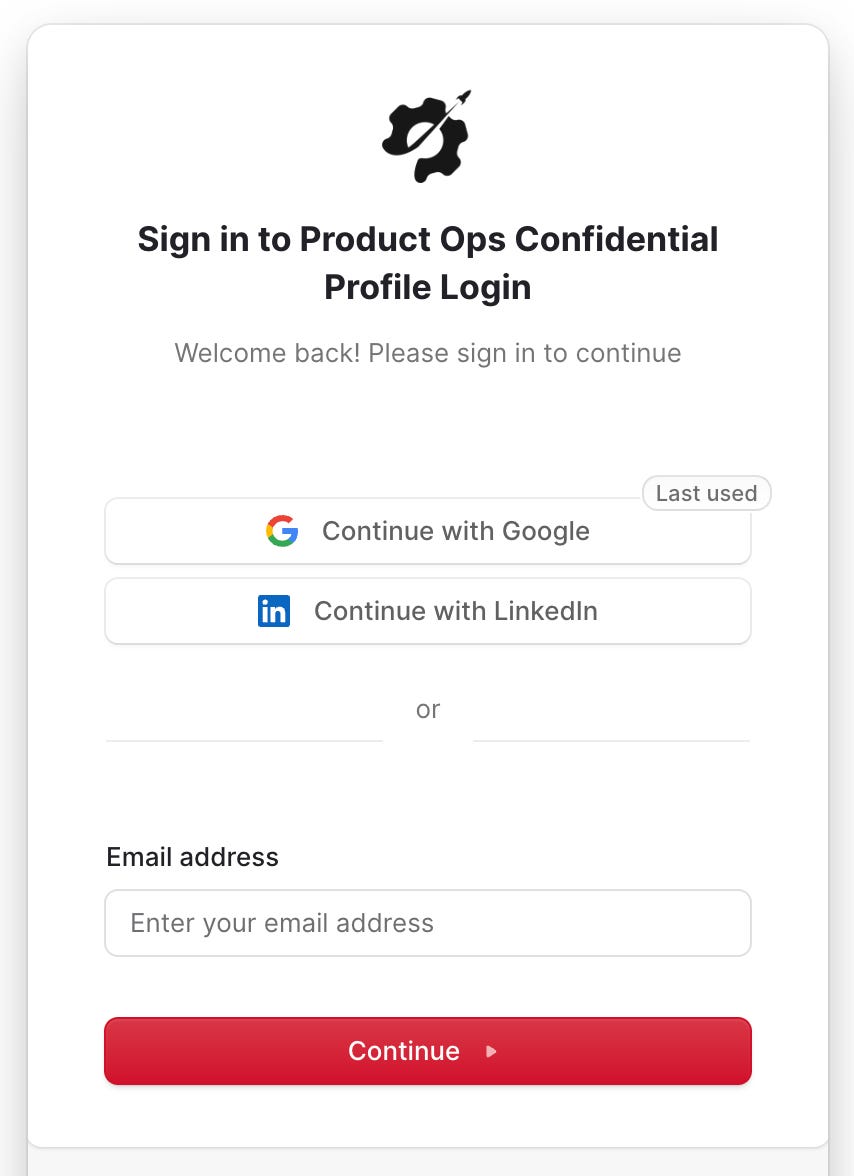
What began as “let people see their own profile” grew into something a lot more useful. The app now runs seven distinct features, all wired to our existing, growing, centralised, Airtable data:
Profile Management. Several dozen fields across nine sections (About You, Location, Working Preferences, Career, Product Ops Experience, People Management, Other Experience, Partnerships, Consent to share). Members fill this in themselves when they first sign up, replacing the old Airtable form completely. After this first time, all data is editable by them.
Recommended Jobs. Jobs matched to a member’s profile appear on their personal dashboard, each linking through to the full listing. Only active jobs show, and they drop off on their own once a role stops accepting applications. This now links both the jobseeker database to the jobs database Product Ops Confidential provides - free of charge.
Resources. The five most recent articles and five most recent podcast episodes from our main website, pulled live via RSS and sorted automatically. Nothing to update by hand. Publish on Substack, and it appears in the app.
Testimonials. Members can submit testimonials about their experience with Product Ops Confidential. A consent setting controls how each one shows: anonymously, with name and position, or privately, visible only to the person who wrote it, of which we are grateful for the kind words every time.
Surveys. A live list of active surveys, controlled from an Airtable table. Add a survey in Airtable, it appears in the app. Switch it off, it disappears. No code changes.
Subscription Status. Members see their Substack subscription status (Free, Monthly Paid, Yearly Paid) on their profile. It is not synced live, as Substack gives us no API for it, but it is populated from our subscriber data. Little bit of a shame it’s not live but still useful.
Six key features, all reading and writing live data, in production in ten days. I am proud of that pace, and of the fact that none of it depended on a budget, a hire, and in the real world, minimal paid-for tech upfront.
And in truth, the 10 days was bits here and there in the evenings and weekends - if I were to do exactly this again, probably about 4 hours front to back. Less if I just used the template I now have.
The Decisions That Mattered
Building software is not really about the code. It is about the decisions. The AI can write code all day. The value I brought was knowing what to build, what to leave out, and when to push back on complexity. I brought Product Management to the table.
On behalf of my entire industry - PRODUCT MANAGEMENT IS NOT DEAD. The decisiosn on what to build, not to build, and when, are still in our hands.
A few calls that mattered:
Clerk User IDs instead of email for authentication. Early on, we used a member’s email address to link their login to their Airtable record. Then I asked the awkward question: what happens if someone changes their email to match another member’s? That is a real security hole. So we switched to Clerk’s immutable User ID, a system-generated identifier that never changes, whatever someone does with their email afterwards. The AI laid out the options. I made the call. In fact, I asked the question too, not AI. AI tools are not great yet about asking ‘What Ifs’.
Auto-provisioning instead of manual record creation. When a new member signs up, the app creates their Airtable record automatically, pre-filled with their email and Clerk User ID. They land on a blank profile in edit mode, with a welcome message waiting. This is what replaces the old intake form, and it is a better experience, because they can come back and update their details whenever they like. One place for everything.
Not building a custom survey engine. The temptation was to build a proper in-app survey tool, with dynamic questions, response tracking, the lot. Instead, we link out to Airtable Interface forms and manage the survey list from a simple Airtable table. It took about twenty minutes to build and covers 90% of the need. Knowing when not to build something is its own skill. So easy to go down a rabbit hole here for something we don’t use a great deal right now - and even without checking I bet good money there is a dozen survey infrastructures we could use to supply this out of the box.
A security audit before launch. We ran a formal security audit of the codebase and found eleven items, one of them critical. All six priority items were fixed before a single member saw the app. This is the bit that separates “I built a thing” from “I built something I am comfortable putting real member data into.”. Once again, I asked the ‘What Ifs’, thinking about scenarios before the happen and looking weeks and months into the future. AI out of the box is not covering this, like a human would/should.
What This Means for Product Ops Anyone
In case it was not clear already - I am not a developer. I have a Computer Science degree from two decades ago, I can write some simple SQL, VB back in the day, and I know my way around Airtable, but I have never anything close to written production JavaScript in my life. Every line of code in this application was written by AI, from my descriptions, my decisions, and my testing. I was the product manager, the designer, the QA team, and the release engineer. The AI was the developer.
This is not a gimmick or a proof of concept. It is a production application, on a custom domain, holding real member data, handling authentication, real live infrastrcuture with industry-proven technology, reading and writing to a database, enforcing its own security controls, and serving live content.
For Product Ops professionals, that opens a door that used to need a development team to walk through. Need a custom dashboard for your stakeholders? A self-service tool for your product teams? A reporting layer that pulls from data you already hold? The gap between “I wish we had this” and “I built this” has never been narrower.
But heck - I really do believe anyone with a logical mind, a disciplined approach, and able to think ‘what if’, can do exactly the same. Are there some concerns over the proliferation of ‘hobby apps’ without thinking about the what ifs, think to at least ask about security - yes I do. And I think it is something critically overlooked in the deluge of ‘AI replaces engineers’ and ‘If you can’t go build yourself you are obsolete’ guff on social media. BUT, the capability really is there.
There were a few bumps along the way, particularly in getting the v1 infrastructure uo and running and smoothe, the jouney from logging in to seeing what I wanted seamlessly took a few iterations (and tokens… ergo, money). In truth, about 50% was down to things I needed to do in the infrastrcture tools, that only I could do, and the instructions from AI were not clear of inconsistent.
This is something I have found often when asking for step by step instructions to do something in a platform. It’s understandable, because AI does not know - it can only go on what it learns from official docs, SDKs, support articles and blogs it finds. This does open up an interesting point I was chatting with Antonia about recently, how documentations is really making a comeback in the age of AI! Not for us (I remember conversations a decade ago along the lines of ‘our product should be so intuitive, no one needs documentation’. And here we are, needing documentation for a new (artificial) generation.
What Comes Next
The app is live. Members are being invited as I write this. The first round of feedback will shape whatever comes next. I have a few ideas, and this actually depends on where Antonia and I want to take both it and Product Ops Confidential.
But the real next step is not a feature. It is finding out what the community actually wants from a platform we can now reshape in an afternoon. The best Product Ops work has always been about building the right thing, not simply building things right.
For years, the answer to “can we build that ourselves?” was “not without a developer we do not have.” That answer has changed. If you have ever stared at a manual process, squinted, and thought you could do better, here is my report from the other side: you probably can. I did, in ten days, for the price of my own time.
Graham
The Product Ops Confidential platform is currently in Beta. It is particularly useful to Product Ops jobseekers Antonia and I know in some capacity and can recommend confidently to hiring managers and organisations we come across. You can supply your job search details to help us, and where we do find jobs we DON’T have connection to, we post the details in our database to try and match your preferences to the right jobs.
Outside of this, are tools to interact with our content and with us.
If you are interested in joining the platform, get in touch with Graham via LinkedIn (for now).