

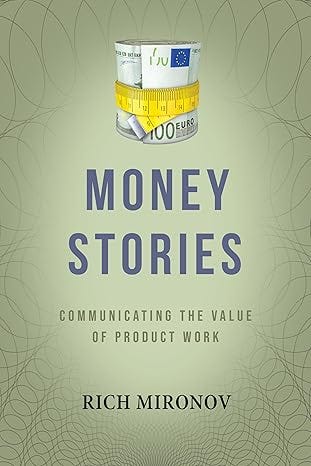
Money Stories by Rich Mironov - Review
Don’t bring a backlog to a gunfight. Or the boardroom.

Your executive team cannot hear you.
Your roadmap presentation might be a thing of beauty, but if it does not contain a number with a currency symbol in front of it, the person who signs off the budget stopped listening three slides ago. That is the argument of Rich Mironov’s new book, Money Stories, and he is absolutely right.
Rich is about as close to product management royalty as this discipline gets. Forty years in and around software. Six startups, three exits. Fifteen stints parachuting in as CPO, and previously wrote The Art of Product Management.
Money Stories is short and to the point - 88 pages and about an hour’s read, and is subtle as a brick through a window. That bluntness is exactly what is needed for a topic that has very little wiggle room. It doesn’t dress anything up: This is not “aligning product to business outcomes” in the soft, conference-keynote sense - which in 2026 is honestly just boring and repetitive.
It is money. An actual number, with an actual currency symbol in front of it.
Stop attaching money to features. Attach it to outcomes.
The heart of the book is a set of money story patterns. Upsell. Boosting volume. Retention. Churn reduction. New customer acquisition. Market entry. Operational cost saving. Look at what every one of those has in common. It is an outcome, not a feature. The moment you say “we are building SSO”, the room hears cost. The moment you say “this unlocks the enterprise tier we cannot currently sell into”, the room hears money. Same feature. Completely different story. Rich’s instruction is to stop pinning the value to the thing you are building, and start pinning it to what that thing changes.
And it is important to pin a value. Don’t stop with “this unlocks the enterprise tier we cannot currently sell into” - follow up with “and is worth £10m a year”. We’ll come onto this next.
Before I do, an important nuance on features and outcomes (yes, that argument again). I cannot agree more with Rich when he stresses the fools’ errand of trying to put values on individual features. Just… just stop it.
Three numbers and an operator… and a baby
A money story has no more than three numbers in it, and you only ever multiply. Two of the numbers you already know. The third you reach into the air and estimate.
So: twenty-five thousand subscribers on the cheaper tier, times a hundred pounds of annual upcharge, times a hopeful ten per cent who trade up. Call it a quarter of a million pounds. That is the whole story. And the instant there is a “£250k” in the sentence, you have the room’s attention in a way no burndown chart or Miro board has ever managed.
The wizardry here is in the constraint. Three numbers, one operator, always a range. That puts the sum within reach of every PM, not only the ex-consultants who go all doe-eyed over a (data) model.
Ballpark on purpose. Precision is the enemy.
Accountants with a nervous disposition… look away now. Rich is not trying to be accurate. He is trying to be roughly right, loudly. His rule of thumb (which he has called out in podcasts and events on his book tour!) is that if you land within a factor of six, you are doing fine. Yes, that will feel deeply uncomfortable if you are the sort of person who believes in decimal places. But the number was never a forecast. It is an attention device. No framework or formula in the world will accurately forecast the success of your product… so just stop trying.
This also means a money story behaves like any prioritisation method we already use. ICE, RICE, weighted scoring. The score’s job was never to be true. Its job was to let you rank and choose. Trying to be precise too early is a trap. You vanish into a spreadsheet for two weeks and produce a figure that is precisely wrong, and three weeks late.
Short, blunt and crisp, and that is the point
This book respects your time. The brevity is not laziness. It is a rhetorical act. The book models the very discipline it preaches (say the essential thing, then stop), and it would be a weaker book at twice the length. The examples are crisp because they are concrete. Rich does not theorise about “value articulation frameworks”. He puts a subscription business on the table and does the sum in front of you.
The Verdict
A masterclass in saying one thing extraordinarily well. And in that spirit, this review is equally succinct and to the point.
I was fortunate to hear Rich discuss Money Stories, both the book and the concept, IRL earlier this year (2026), and honestly, I was hooked, as were many in the room.
This book does one thing: it explains the money story mechanic, but it largely assumes a clean commercial model to aim the maths at. If you live in platform, internal tooling, the public sector, or any world where the value is real but the revenue line is indirect, you will do more translation work than the examples let on. But that is a boundary rather than a flaw, and to his credit Rich is honest about where the technique stops. Or rather, just needs some additional thinking.
If you are a Product Manager, read it this weekend (you literally can in a couple of hours) and pick one roadmap item to retell as a money story on Monday morning.
If you are a product or engineering leader who is tired of being the last consulted and the first cut when budgets tighten, this is the fastest route to being in the room where the money decisions actually happen.
Because the roadmap never gets funded in the language of features. It gets funded in the language of money.
For Product Ops: the level of specificity is deliberate. So teach it.
The most valuable move here for Product Ops folks is not simply to teach teams to build money stories. It is to teach them that the level of specificity is a deliberate choice. Not exact. Deliberately not exact.
A money story is calibrated to do three jobs and no more. Get attention. Open a conversation. Let you weigh one opportunity quickly against the others on the pile. Too vague and it gets ignored. Too precise and it becomes both slow and quietly dishonest, because that decimal place is pretending to a certainty you do not have. Helping teams find that middle setting, enough to be heard but not so much that they drown, is enablement work of the highest order.
Graham
Look out for Rich joining Antonia and I on the Product Opscast very soon!